Episode 109: You Can’t Level Up in a Crowded Room

What if the chaos in your life isn’t a sign to hold on but a signal to make space for something new? In this episode of Babies and Business, Avram and Rachel talk about the Law of the Vacuum and how clearing space physically, mentally, or emotionally creates room for growth. They share the story of their big move and the mindset shift that came with it. Sometimes peace and progress begin when you finally choose your own challenge.
They open up about the fears and surprises that came with uprooting their home and routines. You’ll hear how discomfort can actually become a doorway to clarity and new opportunities. This episode is a reminder that when you create space intentionally, life always finds a way to fill it with something better.
Show Notes
Key Highlights from this Episode:
- Avram and Rachel introduce the Law of the Vacuum, a principle that says nature fills every empty space.
- They explain how making room physically, emotionally, or mentally creates opportunities for new growth.
- The episode shares their personal story of moving out of a home they’d outgrown and what that experience taught them.
- Avram reflects on how choosing your challenge leads to empowerment instead of passively reacting to life.
- Rachel talks about the fear and chaos that came with change and how it ultimately brought peace and clarity.
- Together, they unpack how discomfort can be a sign of growth rather than failure.
- The conversation encourages listeners to intentionally create space for new possibilities in life, business, and relationships.
Episode Transcription
Below you will find a transcript of this entire podcast episode. Enjoy!
Avram: Rachel and I want to introduce you to a concept that’s really changed how we view life, the challenges that are presented to us, and how we engage with them. I think this concept, in a way, feels like a cheat code that’s been right under my nose for a long time. I’ve witnessed it in action, but it was finally put into words and has become something tangible, useful, and that you could implement and really have more peace in your life.
Rachel: For sure.
Avram: Yeah, for sure. Perspective is how we can shift a lot of things in your life. So we’d love to help with some perspective with this law.
Rachel: Yeah, so a good place to start on this is with a concept called the Law of the Vacuum. The Law of the Vacuum has to do with nature’s desire to fill every space that exists.
Avram: Yeah.
Rachel: You think about water—water fills every space it can get to. Air fills every space that it can get to. If you’ve ever done a spring cleaning, you know, you open up all of this space, let’s say in your garage, and you’ll notice that when you do that—or like literally if you clean your house—new energy and new ideas and new possibilities start to show up almost immediately.
Avram: Yeah.
Rachel: Or maybe you’ll fire a client or lose a customer. What usually happens right after that—
Avram: You get more.
Rachel: Something else shows up right away, right? So that space doesn’t exist for very long. And I’ve noticed over time that if you look at how you might lose a friend—
Avram: Yeah.
Rachel: You lose that friend and somebody else will show up.
Avram: Sure.
Rachel: But who do you say yes to? You know, the first person that shows up—you have a choice. Do you let them in, or do you wait for somebody or something else to show up?
Avram: Or do you actively go out and seek the friend? You can wait for the friend to come to you, or you can go out and find people—actively search for that person to fill that space.
Rachel: Exactly.
Avram: Divorce, you know, friend or whatever.
Rachel: So if you have some kind of intention around it, what’ll happen is you’ll notice that instead of repeating the same pattern over and over, you choose something different with intention. And suddenly, you are upleveling that friend circle, you are upgrading your business revenue, you are changing the energies in your household.
Avram: Yeah. Yep.
Rachel: This is a great jumping-off point for what we wanna share with you.
Avram: Yeah. You know, it is just a really cool thing that we can choose to actively do these things or we can choose to passively do them. So actively choose a friend to fill this void once we go through a divorce or the end of a relationship—or we can passively just let things happen, and then maybe we’ll get back into an abusive relationship or whatever that might be.
But, whoa—we chose something pretty big in September.
Rachel: We did. And there’s this saying that keeps going off in the back of our heads. Our good friend Keala shared this—he said, “You can choose your challenge, or your challenge will choose you.”
Avram: Yes.
Rachel: It’s like—well, your life always has some level of challenge.
Avram: Yeah.
Rachel: Have you ever met somebody that wasn’t challenged in some way? You might not have seen behind the scenes what the challenge is, but I guarantee you that person has their own demons, their own struggle, and their own challenges.
And if you look back on your life, there might have been periods that felt like you didn’t have much—
Avram: Yeah.
Rachel: But those periods were not long before another challenge showed up.
Avram: Sure. Yeah.
 Rachel: So, for us, we look back at the fact that we chose something and the outcome of it. We chose to move out of the home that we had been living in—you had been living in for about nine years—and we chose to find another place to live.
We had outgrown the place, and we had been acting passively, I think, by staying there for so long. We had our first child, and it was a little tight. It was uncomfortable that we didn’t have a tub in any room other than the master bathroom. So that was quite a thing, but we stayed there for quite a while, and passively those challenges came in.
We had another baby. We then started sharing our office with our baby, so he would sleep there—all sorts of things.
Avram: We were like—
Rachel: In that small space.
Avram: We’re like dealing with these challenges that were getting thrown upon us.
Rachel: Yeah, I mean, just one day—I think we might have told you this story, but it bears telling again. Here I am—I knew at this point that I wanted to move, and I had chosen the place that I wanted to rent and wanted you to see it.
I felt sick that day—I didn’t want to tell you. And there were these things that came up, all in the same day, when I was feeling like I really didn’t want to tell you that we should move. You were recording a ton of videos—25 in a week—and we had ruined three of them.
Avram: Because it was so noisy in the house.
Rachel: Zuna had to be put outside at one point, and she ruined a video. Then one of the babies cried—ruined another. Then Lincoln got up from his nap and needed to go potty, and the bathroom was right next to the office, and that ruined a video again.
So here I am juggling this baby at 4:30. The toddler’s still sleeping. I don’t see that as a blessing or a benefit—I see it as a challenge. It’s not a benefit that my toddler is still sleeping; it’s a challenge, because my baby can’t sleep in that room. He has to sleep in the master bedroom.
I had to take the pack and play into our bedroom, set it up, put the baby in. So all these challenges came knocking that day saying, “Do you really want to stay in this place?” The answer was no.
So the challenge really showed up, and that was the thing that got us to move. We realized we wanted to make this change, and then the challenge was actually moving forward and taking the action.
Avram: Well, before we—yeah, to define it. The next part—all of this felt like it was happening to us. We were in reaction to it—it was all being thrust upon us. And it’s like, well, why are we dealing with all these types of problems?
Rachel: And I was getting frustrated at you—there were all these things, yes.
Avram: Why are we dealing with them? It’s because we have been passively waiting around, not taking action, not actively doing something about them.
Rachel: Correct. And just thinking that magically they’re gonna fix themselves.
Avram: I don’t know if you were thinking that. I think we were just not even—we were just like, this is how life is. This is our lot right now.
Rachel: And it had never occurred to us until this point that there was a different way—that we did not have to continue to endure these challenges. We could rise above them, choose something different, and have our reality be totally different.
Avram: So what we chose instead was to be intentional.
Rachel: Mm-hmm.
Avram: To become active as creators in our lives, and to choose something different. We had to jump tracks and do things way outside our comfort zone.
Rachel: Oh yeah.
Avram: So we more than doubled our rent. We spent nearly $10,000 just to move 15 minutes across town—first month’s rent, last month’s rent, paying an extra month of rent in the old house because we wanted time to move. The moving truck ended up costing twice as much as we planned for.
Rachel: And then the time that it took, and us—the challenge that we chose was the unknown about the cost, the inconvenience of spending our time on moving instead of working or other things, and then getting into this house and having a landlord that’s kind of crazy.
But all in all, looking at the challenge that we chose—I still would’ve chosen that challenge versus the one we were continually facing in the other home. So we just changed the challenge.
Avram: Changed the challenge. It’s the same level of intensity. I would say that what we also did was compress all the intensity we’d been feeling in our old home over months—
Rachel: Years, even.
Avram: We mirrored that intensity into a single month of September with our move and the chaos of it.
Rachel: The move was chaotic. I mean, the timeline was—we got back from a trip and had less than a week to prep.
Avram: We packed it all in like three days, with babies.
Rachel: We came home from a trip, and yes, we had—
Avram: Told y’all about this story a couple of podcasts ago.
Rachel: Yeah. So we had that happen. Then a couple weeks after that, we had a camping trip. Then another trip. So within four or five weeks, we had all that, plus the move—which did not go smoothly.
We did not get everything packed into the trailer we personally packed. We had to go back multiple times, rent trailers, all while managing other plans and trips.
So all scrunched into one month—but we chose it, because we knew on the other side there were benefits that were complementary to that challenge.
Avram: Well, it’s like—you think you leave one space, move to another, and all your issues go away. No—they just change. There’s no “happy ending” where you frolic into the forest with butterflies and rainbows. There are still wolves.
In this case, we recognized that where we wanted to go was bigger than that small house we were living in. We can either continue to literally fit our lives into a small space—or choose the challenge, which includes having to uplevel to provide for the new expenses and navigate a new landlord.
Rachel: Yes.
Avram: What’s super interesting is we’ve looked at this with the house—this is the example we wanted to share—but we’ve also looked at it in business. We’re leaning into growth, hiring, managing more revenue, and all that comes with it.
I’d rather deal with those challenges than with the challenge of staying stagnant—cutting costs, scaling back. Those challenges suck.
Rachel: Yeah. And what’s really cool is we gained some clarity and honesty around our situation. The clarity was—this is difficult. The honesty was—this isn’t working for us.
It actually had to become so painful for us, and that was the catalyst to move on. Moving forward, we want to carry this perspective: seeing life, seeing choices, and choosing the challenge—rather than letting it choose us.
Avram: Yeah.
Rachel: While the challenge has changed and morphed, the benefits have also changed. One of the biggest pain points in our old house was space. We had only three bedrooms and needed one for an office.
We were literally limited by our babies’ sleep schedule for when we could work. When August went to bed, no more working unless we moved the entire setup into the dining or family room. It was exhausting.
Now, we’re just really excited to be here, recognizing the contrast between challenge and benefit.
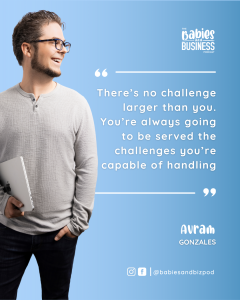 Avram: Yeah. And you know, there’s no challenge larger than you.
Rachel: No way.
Avram: You’re always going to be served up a challenge you can handle. And that’s worth remembering, because when those things come up, it feels intense. You might recoil—it might take you days to process the weight of something new.
But when you come around to it, you have the opportunity to embrace it and level up from it—because the other option isn’t one I want to take.
Rachel: No way.
Avram: So let this be a reminder that you can play life actively and chase down your dreams and challenges—because you’re equipped for them.
Rachel: Absolutely.
Avram: Or you can live life in reaction, responding to things you feel unprepared for.
Rachel: Yeah. You’re going to live through them regardless.
Avram: You live through them regardless. And it’s crazy—the universe abhors a vacuum. So when you choose the challenge you want, there’s no space for the other ones. And if those other ones come up, they feel like nothing compared to the big one you’re facing each day.
Anything else you’d like to add?
Rachel: No, I think that’s great. I’m just really excited to share what we experienced and hope it makes a difference for you. This slight mindset shift—seeing challenges—they’ll always be there, but we get to choose.
Avram: That’s right. So we appreciate you listening to this episode. If you haven’t already, give us that five-star rating on Apple Podcasts, Spotify, wherever you’re listening—it helps others discover the show and tune in like you do every week.
We appreciate you for listening. We’ll catch you in the next one.
Rachel: Bye for now.