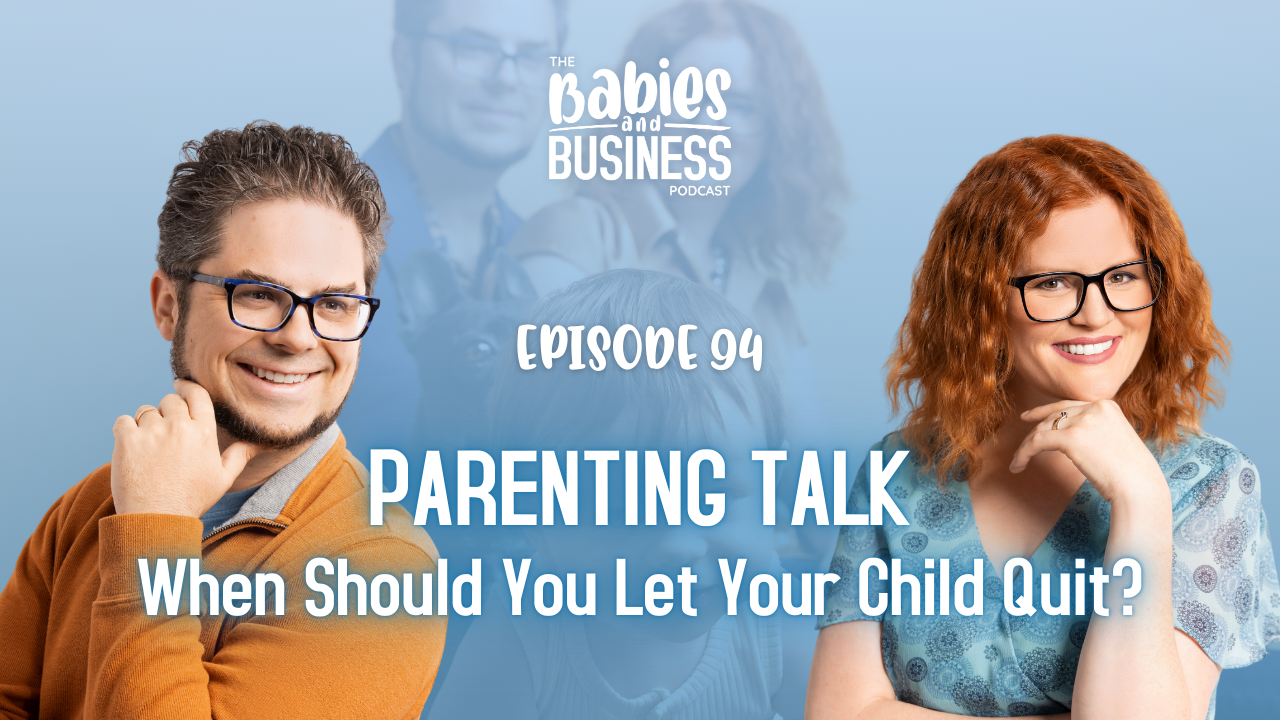
Episode 94: When to Quit: Making the Right Call for Your Child
 Most of the time, as parents, we’re faced with quiet questions that don’t have easy answers. In this episode, Avram and Rachel talk about something most parents face at some point: when to quit.
What do you do when your child suddenly loses interest in something they used to enjoy? Do you keep going and hope it clicks again, or take it as a sign to move on? They share their own experience of navigating this kind of shift, the questions they asked themselves, and how they made peace with changing course.
It’s a reminder that parenting decisions don’t have to be permanent, and it’s okay to pause, pivot, or let go when something no longer fits your family. If you’ve been in that in-between space, this one’s for you.
Show Notes
Key Highlights from this Episode:
- Avram and Rachel share how a once-fun activity with their son started to feel like a struggle, leading them to ask: When is it time to quit?
- They reflect on why they signed up for Kid Strong in the first place (structure, bonding, and fun) and how those reasons changed over time.
- Learn how shifting routines (like starting Montessori) can reveal when something no longer fits your child’s needs.
- Hear about the guilt and second-guessing that often show up when making hard parenting decisions.
- Explore the pressure parents feel to “stick it out” even when it’s not working anymore.
- Discover how letting go of an activity isn’t the same as giving up; it’s choosing what’s right for your family now.
- Be reminded that quitting with intention can open the door to something better, and that you’re allowed to pivot.
Mentions & Resources
Kid Strong – A developmental program for kids that combines physical activity with social-emotional learning, confidence building, and structured skill development.
Episode Transcription
Below you will find a transcript of this entire podcast episode. Enjoy!
Avram: Hello. Hello. Welcome back to the podcast. We just had this amazing date morning now that our children are both, uh, being cared for on a regular basis. We had like three weeks there. We didn’t have childcare. We took the morning, dropped them off at Montessori. Went to the gym together, drove to the Hyatt Regency Tamaya, had an amazing breakfast, and we were like, let’s go back and do some podcasts.
Today, we want to chat about something that’s been up in our life that I know that every parent struggles with, and every entrepreneur knows very well, it’s knowing when to quit.
Rachel: Yeah.
Avram: I think that most entrepreneurs are geared to just double down, keep pushing forward, make sure it’s done.
Rachel: And sometimes it feels like a grind. Sometimes your work feels like a grind, so it can be confusing maybe, or, may take a little bit more effort to figure out, is this just a grind that I need to keep going, or is this a grind because it doesn’t work?
Avram: That’s exactly it, and what we want to explore in today’s podcast.
Rachel: Yeah.
Avram: So what’s going on right now?
Rachel: Well, you know, we are faced with this decision of, do we keep doing this thing for Lincoln, you know, we take him to Kid Strong and it’s this place where he has some structure and it’s kind of like a gymnastics kind of thing, you know. They’ll put up these little things for them to do these little like really things and he’s just not interested.
Avram: So we started with Kids Strong about a year and a half ago, actually, almost two years ago, it’ll be like two years in like October. And the reason that we started it was we just had, you know, a nanny at home with him. You are pregnant with our second.
Rachel: Yeah, we start, he started before the nanny.
Avram: And we were going, because, we don’t have, at the time, many friends or any friends that had kids or you know, his age. And so we were like, okay, how do we get him some socialization? How do we get him some structure
Rachel: Yeah.
Avram: Right? And then, you know, what can we do?
What, what can, what can dad do to increase the bond with our son?
Rachel: Yeah.
Avram: So that program really ticked all those boxes for us.
Rachel: It really did, and it was a lot of fun. Sometimes it was work because, I mean, things with kids are, are often work, but he just had so much fun with the different kids, the different things that they did, different skill levels that he was learning, he was doing things there like balancing on this little beam.
You know, trying to walk up it. And for the first couple of times he couldn’t do it without help and then he did it just he knew, oh, put one foot in front of the other and then he got it. So it was cool to see how he was learning things and doing things that we wouldn’t normally do at home. So that was one of the things that was also really enjoyable to see as a parent.
And for him to see other kids doing things and then going along with that and seeing how things were done.
Avram: Yeah. And then when you got pregnant with August, and especially towards that like third trimester, you didn’t have the energy for him much at all.
Rachel: Right

Avram: Right. And so, you know, before August arrived and then for at least a couple months after that activity for Lincoln and I was the time that he and I would go and it felt like this is our special thing. In some ways it was an escape from what was feeling like a sort of a stressful life at home for a period of time.
Rachel: Yeah. A lot of work.
Avram: A lot of work.
Rachel: With a baby.
Avram: And that has definitely changed for us in the last several months.
Rachel: Yeah, and part of that change is now, Lincoln is on his fifth week at Montessori preschool and there’s a lot of structure. Not necessarily in the exact things that he will do throughout the day because those things change. It might just be that this time period in the day is for this kind of thing, and then this time period is for this kind of thing.
But we’ve seen him actually draw back with kids strong. Like, he’s not interested in doing the thing they say is going to happen right now.
Avram: Yeah.
Rachel: And our thought. So we wa
nted to kind of walk you through the thought process of, well, how do you know that this is just a hump that we’re gonna get over and just keep moving forward? Or that this is actually something that’s no longer enjoyable to him and he needs a break.
Avram: Yeah. I have watched with this particular age group, I have watched a lot of parents there with their children. Eventually drop out when their kid is around three or you know, aging up a bit. ’cause it’s just like this independent phase where they want to do things their own way, so they want to push against the structure.
Rachel: Right.
Avram: And so I’ve seen a couple parents make it through that to the other side and it looks like they’re having fun. And then, you know, we are now having the experience that I watched others go through and it has been really hard.
Rachel: Right. And sometimes I’ve seen you rallying. You get back and you’re like, whoa, that was hard. But you know what? We are in it. We’re gonna do it. We’re gonna make it through. I’ve seen other parents make it through. We’re going to keep going.
Avram: And it was like these last two weeks that I took him where I was realizing like, okay, I don’t think this is working anymore. And, and I talked to Rachel. I was like, what do we do? Right. And so the first thing that I did was brought it around to why did we start this in the first place?
What is our reason for going?
Rachel: Yeah.
Avram: Because in the moment it was like, I’m asking myself, do we keep going? Like, do we just go to the next class? But I needed to step way further back.
Rachel: Yeah, because we also had to remember. Who did we start doing this for? It was for Lincoln.
Avram: Yes.
Rachel: His enjoyment, his development, his involvement, all those things. And you’re competitive and you see the goals, like, oh, we’re gonna rank up to this thing, or we’re gonna do this. You know, you have that perspective but a 3-year-old doesn’t have that perspective and all he knows is that he goes and he’s just not having fun.
Avram: Yeah. And so, we started with him in mind for the structure.
Rachel: Yeah.
Avram: Right? And then it became pretty clear that it was also an opportunity for him and I to bond and have fun together.
Rachel: Absolutely.
Avram: Right? So structure, bonding, having fun. And when we looked at that and then compared it to the last few weeks that we were there, I’m thinking about the last class that I was at with him.
You know, they’re setting up these little obstacle courses. Well, he wants to go the opposite direction of the course. If there weren’t people coming back around that way, it would be fine. I would just let him do whatever. But instead I’m like, we can’t do that, bud, we have to keep going this way.
And what is a three-year-old’s response to that?
Rachel: Noooo!!!
Avram: You know, nooo!
Run to the corner, throw a fit about it, and then sit there, because now I don’t want to do anything that’s here. And it’s like, great. So we’re gonna come here and sit around for 45 minutes and watch everybody do these things. You know, I’m not the parent that’s like, we need to do this.
Rachel: Yeah.
Avram: That doesn’t work for me. It doesn’t work for him. So we are just like, what? What are we even doing here now at this point?
Rachel: Because it does not tick the box of fun.
Avram: No.
Rachel: It does not tick the box of bonding.
Avram: Because if you ain’t having fun, you’re not bonding.
Rachel: Correct, and it doesn’t really tick the box of structure because I think it actually overfills him with structure because of his Montessori structure that he has there. So it’s just more structure and I think that he would, as we talked about it, he would just like more fun.
More things to do that he really enjoys. He loves going to the park, he loves going to the pool. He loves going to the park and having friends there. So maybe it’s more play dates that he would like to have in his life. That simple stuff.
Avram: Yeah. And so, you know, the desire to push through and keep going would be like the one reason that we would stay.
Rachel: Yeah. It’s like maybe we’ll get through it.
Avram: Mm-hmm. But at what cost? You know, I see If we stop now, that there may be a time later where he’s like, you know, I would like to do that again. But I think if we keep pushing forward, he will hate it.
Rachel: Yeah. And it could be traumatic, maybe
Avram: will not enjoy it together. There’s just a lot of negative consequences.
Rachel: And I also see it going the way of, instead of bonding as you guys, you boys. You go out with him and he’s just mad the whole time, or you are mad and you come back and you don’t feel closer to him and he definitely doesn’t feel closer to you. I think when we got down to it, we got really clear about, you know, what are the feelings that we’re having?
Is it because we’re scared to move on and we feel like, are we giving up too soon? What are the signs that we’re looking for to know that our child has done and how do we support that and actually bless him to be able to change and become a different person. And then, you know, are we attached to maybe what we get from it, what our perceived things are.
Maybe it’s that we look good in the sight of other parents that other peer parents see us. You know, what are those things that we’re putting on ourselves as the judgments or,
Avram: Yeah. Or like, you know, one of the things that crossed my mind is like, so what are we gonna do instead? And then I’m like, I don’t want to do the work of having to figure out what to do instead.
Filler: Sure.
Avram: The reality is if it’s not working, you have to change it up.
Rachel: Yeah.
Avram: You know?
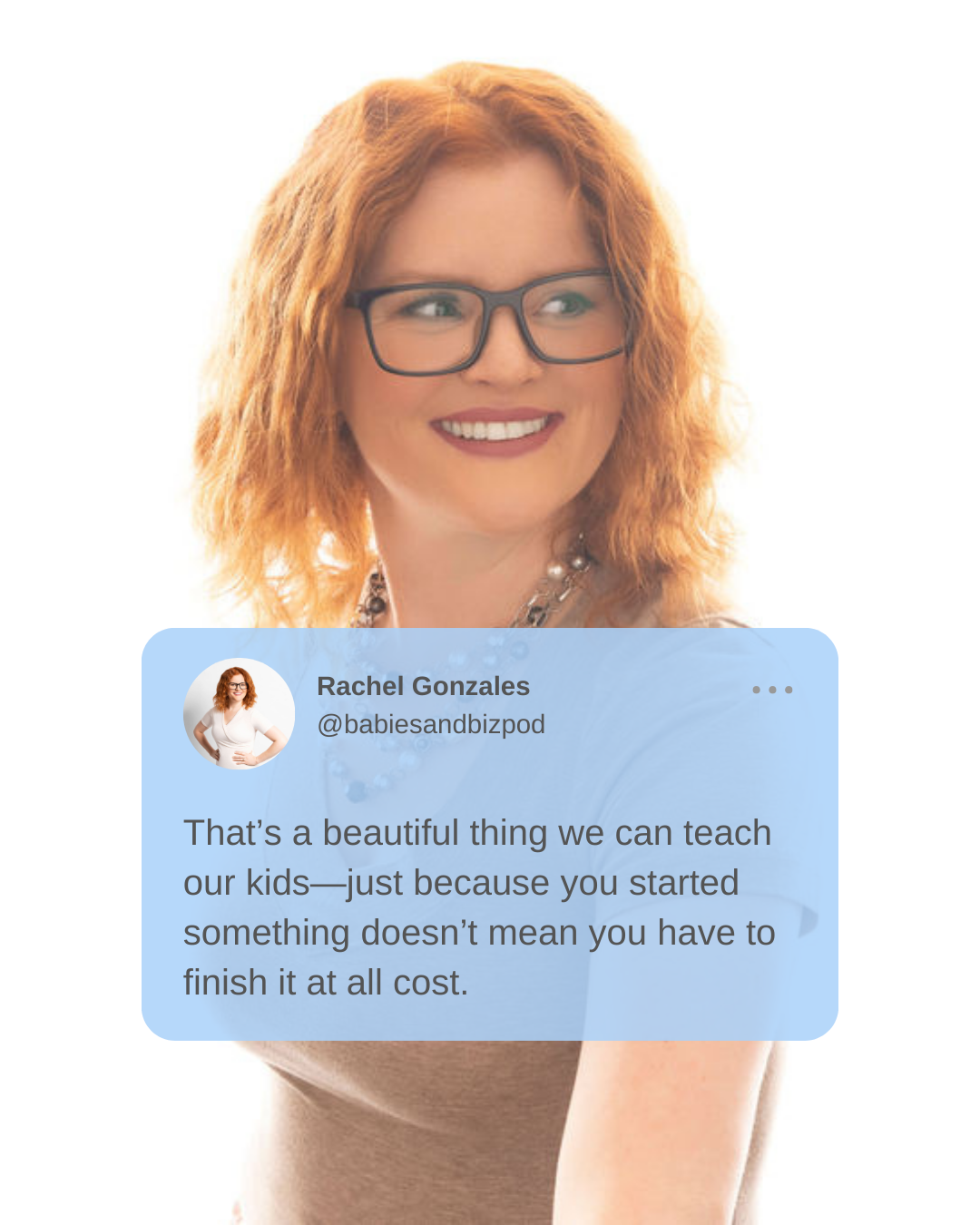
Rachel: Yeah. And really you change it up. You find out if you like something else and you go with that. You, you test that out too. I think, that’s a beautiful thing that we can teach our kids is just because you started it at some point doesn’t mean that you have to finish it at all cost.
You can reevaluate and see if it actually fits in with what you really want and desire for yourself
Avram: Yeah. I think if anything the biggest hangup for me was, uh how much fun we have had there. Feeling like that i’m giving up on that when it could come back. And we already chatted about it. It could come back later. But it’s not gonna come back right now.
Rachel: Yeah. And just take a break.
Avram: Yeah. Exactly. That’s where we landed, over a hundred classes there a good time for Lincoln and I. But it’s time for the next thing. And I guess my challenge to you, the listener is, looking at the stuff in your life right now that maybe has not been easy and asking yourself, okay, am I just doing it ’cause I think I need to do it or should do it? Or is this a, a greater sign to change things up and only you know that only you can be as honest as you can be with yourself in that introspection, but.
Rachel: Yea
h. Well, and I think some of the words that you hear as you’re thinking about the thing that you’re looking to change up is, does the word should come up? Because should, for me, in my experience has often been because it’s, something that’s been injected into my life as something that I should do.
Like my parents taught me that I should do this or value this, you know, so that could be a helpful thing.
Avram: Yeah. Anything else?
Rachel: I don’t think so.
Avram: Yeah, that’s it. We appreciate you for listening. If you got, somebody in your life that’s going through a little bit of a struggle with their kids, twos and threes trying to figure out what’s next for them, maybe send ’em this episode and give them the encouragement and let them know they’re not alone with the struggle.
And you can always change it up. This is your permission to do so. Um, with that, we appreciate you so much for listening. We’ll catch you in the next episode.
Rachel: Bye for now.