Episode 112: The Art of Surrender for Parent Entrepreneurs

Every parent entrepreneur has been there. You have a plan for the day, goals you want to reach, and ideas you cannot wait to bring to life, but then life happens. In this episode of the Babies and Business Podcast, Avram and Rachel talk about how surrendering to what is can shift your perspective when parenting and running a business collide. They share how letting go of control and being fully present helps parent entrepreneurs create more peace, joy, and connection at home and at work.
Show Notes
Key Highlights from this Episode:
- Avram and Rachel return from a 10-day retreat and reflect on re-adjusting to life with their kids.
- They share how every parent entrepreneur faces moments where plans fall apart and kids need attention.
- The episode explores the difference between resisting reality and surrendering to what is.
- Rachel talks about being fully present with their children instead of multitasking or rushing through the day.
- Avram explains how resistance shows up as frustration and burnout in both parenting and business.
- Learn how surrender brings more calm, creativity, and connection to family and work life.
- Discussion on how expectations versus reality can create emotional conflict.
Episode Transcription
Below you will find a transcript of this entire podcast episode. Enjoy!
Avram: Every parent preneur deals with the same struggle. You’ve got things that you want to do, you’ve got ideas on the mind, you want to execute. You’re ready to go with the business. And then what happens?
Rachel: The baby wakes up.
Avram: Uh—
Rachel: You thought they were gonna take this really long, nice nap. Nope.
Avram: Nope.
Rachel: They are awake and it’s been 30 minutes. You’ve barely sat down.
Avram: That’s right. Yeah. And then it’s like, what do you do? You’re faced with an afternoon that could be full of frustration because you’d rather be doing something else.
Rachel: Yeah, you know, you’d have this plan and you were really excited about executing and then your baby is up and needs you and yeah, it is full on.
Avram: It’s full on. So we have something different to offer around this today. I think also some different verbiage to share that’s really helped us move through some of these… I don’t know… I don’t even wanna use the word challenge, but yeah, just feeling split between priorities. And we got back from this retreat, we were gone for 10 days. It’s the longest we’ve ever left our children.
Rachel: Yep.
Avram: And they’re three and a half and one and a h
alf if you don’t know or haven’t been listening for long. And we get back from this trip. And what do you think the first thing is that they want to do when they get to spend time with us?
Rachel: They just wanna spend time with us.
Avram: Just want to spend time with us.
Rachel: Well, and you know, they wanna spend time with us. And what I thought was a beautiful thing that we gave ourself was we drove from New Mexico to Texas and then back. And on our way, I felt like we were able to prep for and create expectations that were reasonable around how we were gonna show up when we got home. So, um, yeah, so they wanted our time and that was what I predicted. We predicted.
Avram: More than our time — our complete and total full attention.
Rachel: Yeah, there was not, “I’m gonna do dishes and you’re gonna be in your high chair.” No, no, no, no. If I turned my back, they were upset. So I didn’t actually go that far. I didn’t actually turn my back on the babies and try to get things done. What I did was, we had prepped to know what that was gonna look like, and we knew that it was gonna be very strictly: when the kids are in school, we are working. And when they’re not, we are with them. Normally it is me that is with them after school and then you continue to work. But in this circumstance, we knew it was going to be important that we were just both present with them. So that they could ease back into us being home and know that we weren’t going to go away again.

Rachel: So we did prep. Part of this episode we’re gonna talk about, like, the difference between expectations and reality. Sometimes our expectations are met with a very different reality and that can cause a lot of distress. And I have felt that tug, you know? Like we said in the opening scenario, you have a lot of things to do and the baby wakes up.
Avram: Yeah, well, you can be in resistance to what they want because you’re trying to achieve or do something else. And that internal resistance, that conflict, makes its way out with anger, frustration, shortness
— all kinds of things, right? And really, just generally not being present.
Rachel: Or being irritated with their sounds, you know? Babies are not quiet.
Avram: No, they’re not. Because the reality is children are a force of nature, right? You think that this small child — you’re like, really? You can enter a room and just dominate everybody with your presence, you know?
Rachel: Well, it’s because they only have one need and that is to survive, and their noise is the way that they get their needs met. Their needs are met by them letting us know. How do they do that most often? By crying.
Avram: Yeah. And so we were presented with this concept of surrender recently, which is really like recognizing what is and then going with it.
Rachel: Just being present with it. Like, my baby wants my attention — I’m going to give him my attention.
Avram: Yeah, like there is nothing that you’re gonna be able to do to change the fact that they want and desperately need your attention.
Rachel: No.
Avram: So what is your choice? Your choice is to resist the fuck out of it…
Rachel: And be really irritated. And be really irritated, frustrated.
Avram: Or—
Rachel: Just show up.
Avram: Show up. Then be okay with it. More than be okay with it — fall in love with it and find joy in going with it.
Rachel: Yeah.
Avram: Because those are really your two options.
Rachel: You resist it—
Avram: Or you surrender to what is.
Rachel: Yeah. So you know, my experience when we came back from this retreat — we got back on Monday and it’s Saturday now — was for the first four days, Monday through Thursday, I was just really, really present with them. When they got home from school, before they went to school in the morning. Just really, really present with them. I knew that the house stuff would happen. We did minor little picking up and the different things that are just required around the house, but not more than that. And just being present with them.
Rachel: And I sat on the floor a lot. They just wanted to crawl on me or they wanted me to pick them up. Or Lincoln wanted to read to me. And I love it when August gets a book — you know, we’ll go and we’ll get ready for bed and we have this cute little sitting area with their books. And August will grab a book and he’ll go sit on his chair. Then he’ll read it for a little while and then he’ll get back up and pick a different chair or pick a different book and then go back to his chair. And they just wanted me to be present with them, sit near them, they wanted to do their thing.
Rachel: And in the past I would have wanted to maybe rush through things because I was somewhere else. I wasn’t actually being present with them, regardless of how much energy I was putting towards just being present with them. And over the last four days, it’s been really awesome to see just me recognizing: this is what they’re wanting, this is what I want to give them. I’m present for it. I’m here. I had zero anxiety. I actually looked forward to it.
Avram: Yeah.
Rachel: I got my work done before they got home. And I was really, really excited to see them and just be present. I mean, I have found myself counting the hours until they would go to bed. We have those days, but that wasn’t these days.
Avram: No.
Rachel: And that’s not what I want for my future or for their future — just waiting until they go to bed and I can have relief from them. That sounds really terrible, but…
Avram: Well—
Rachel: It has felt that way sometimes.
Avram: Oh yeah. Shit’s intense. They are a force of nature, right? And sometimes it takes everything you got to just make it to the end of the day without losing your shit.
Rachel: Yeah. And so what I found — the contrast that I found really beautiful — was the contrast of how I have shown up and how I now show up with them. And the difference was that I have just surrendered to what is. They want my attention and I’m going to give it to them. And it’s a beautiful balance. Moving into the future, it doesn’t mean that I’m going to do nothing when I’m with them, but it’s the energy that I take when I am with them.
Avram: Yeah. Well it’s like, look at what they required after us being gone for 10 days. It’s a different requirement than what is…
Rachel: Just regular. Yeah, exactly.
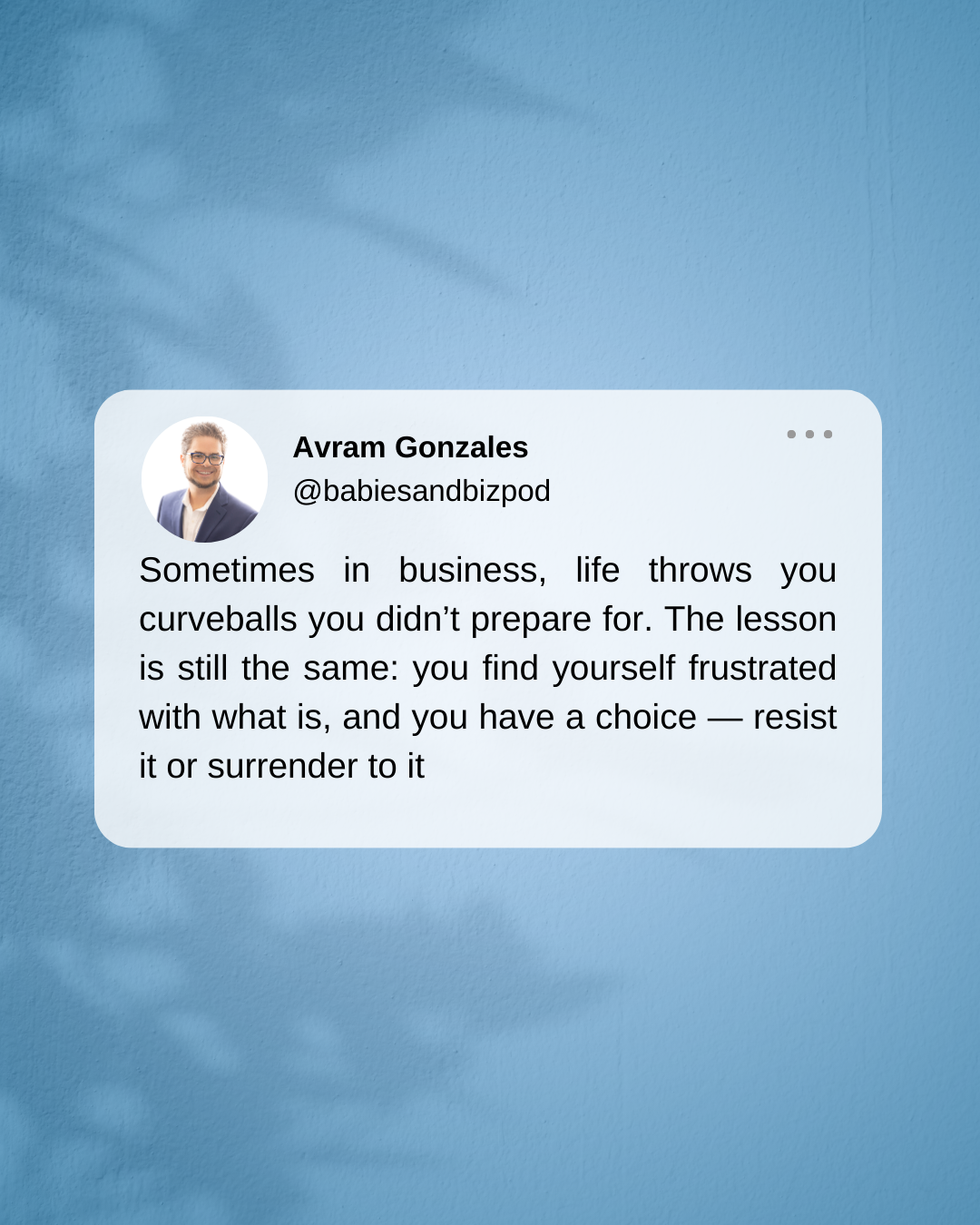
Avram: Regular. So you knew that. You were able to prep for that. Now sometimes in business, life throws you some curveballs — things that you weren’t able to shape your expectations of before they come in. The lesson is still the same. You find yourself really frustrated with what is in the situation — you have a choice.
Rachel: Yeah.
Avram: Resist the hell out of it—
Rachel: Right? “This shouldn’t be happening to me. I shouldn’t be having to deal with this. Why is this happening?” You know. Terrible answers.
Avram: The work truck breaks down — what are you gonna do with that?
Rachel: Yeah. You be mad about it that it even happened, but is that gonna fix it?
Avram: Sure is not. So you surrender to t
hat — it has broken down. And then what do you find? You find, well, these are my best solutions.
Rachel: Yeah. You make some calls.
Avram: Make some calls. And you might find that the makeup of your day was dramatically different, but you can certainly do something different with it.
Rachel: Right, because you could be debilitated by your anger, frustration, disbelief — any of these feelings that you’re having about what has happened and what is — or you could just simply say, “This is where I am. What am I gonna do to move forward?” And all of those feelings left because my expectations met my reality, because I was able to recalibrate the expectations based off of, well, where am I? I’m with children that I’ve been away from for a long time. And they are going to be possibly more emotional, more needy if you will. Probably tired, probably worried — all sorts of things. But just be present for that.
Rachel: So it’s the same thing. Your broken-down truck — you can recalibrate how you’re feeling by just simply saying, “Well, this is what I’m facing right now. We’re gonna move forward.”
Avram: Yeah, it’s a practice.
Rachel: Yep.
Avram: It’s a practice. And as much as you want to as an entrepreneur, you can’t always change reality.
Rachel: No way.
Avram: And so it becomes a game of managing your energy, managing your emotions, and nothing burns you out faster than trying to swim upstream—
Rachel: Yeah.
Avram: Versus going with the current and finding your way through.
Rachel: Yeah. And going with the current is, you know, surrendering to what is — go down the stream a little bit. Take a little break.
Avram: Mm-hmm.
Rachel: And you’ll find some pretty magical stuff when you’re able to feel yourself actually recognize you’re here now, and that’s okay. And it doesn’t mean anything. It just means that this is where you are.
Avram: So with that, we appreciate you for listening to this episode. We’ll catch you on the next one.
Rachel: Bye for now.