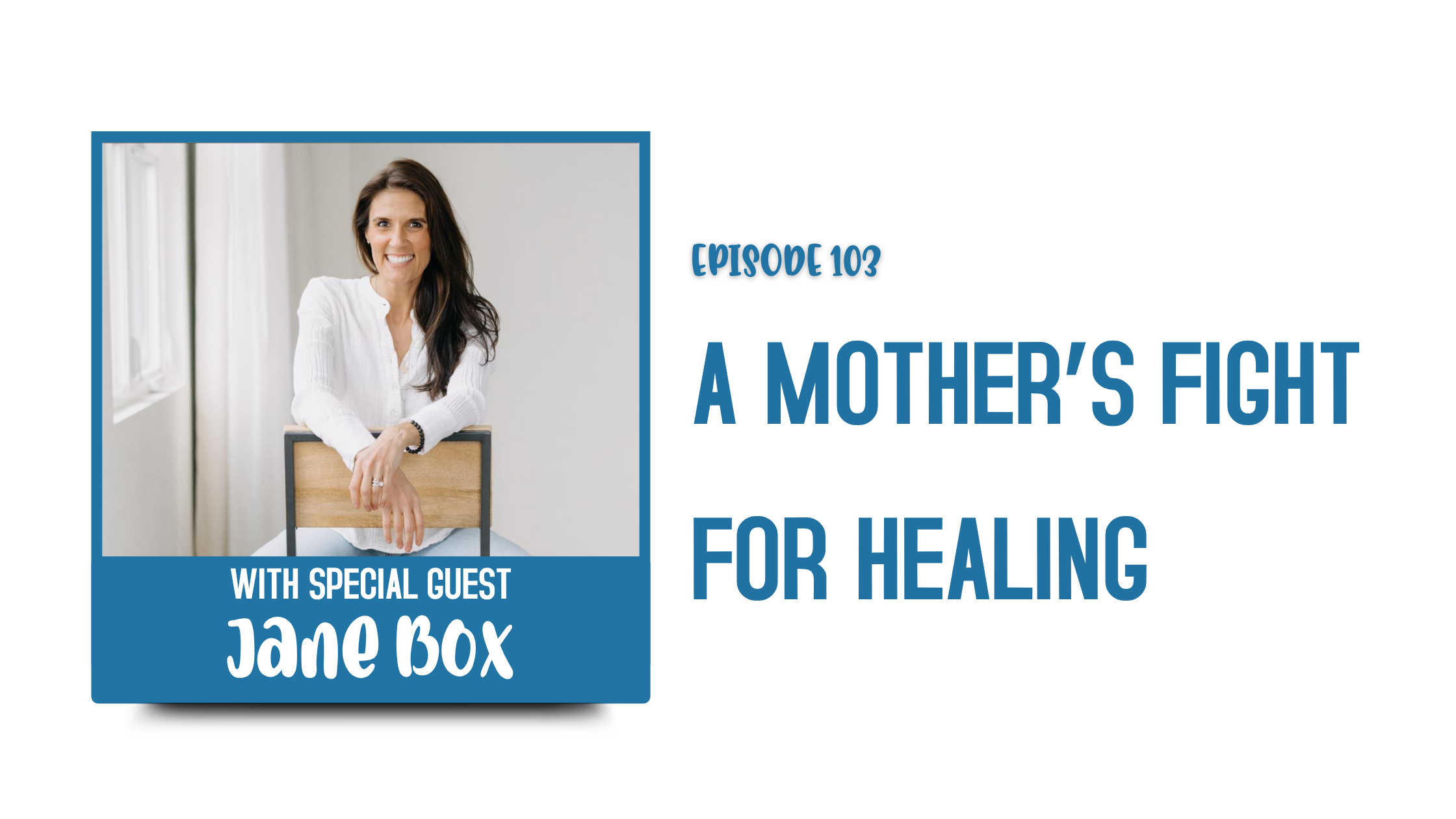
Episode 103: Turning Family Health Crisis Into a Journey of Healing with Jane Box

When your child is sick, you’ll do anything to find answers. For Jane Box, a mom, health advocate, and first-time filmmaker, what began as a heartbreaking cycle of hospital visits, chronic illnesses, and unanswered questions turned into a journey that changed her family’s life in ways she never expected.
In this episode of the Babies and Business Podcast, Jane shares how her children’s struggles opened the door to surprising discoveries, powerful lessons, and a mission to spread awareness. Her experience has not only impacted her family but is now sparking conversations across the health and wellness space, a reminder that sometimes the greatest breakthroughs begin with a mother’s intuition.
Show Notes
Key Highlights from this Episode:
- Jane’s six-year journey through IVF before welcoming her two children
- The exhausting cycle of illness, flu, pneumonia, bronchitis, asthma, eczema, and repeated infections, that left her family desperate for answers
- A mother’s intuition: pushing past dismissals from doctors to demand further testing and life-saving care
- The terrifying health scares her children faced, including chronic asthma, allergies, and a severe reaction to penicillin
- The turning point: discovering molecular hydrogen water and seeing her children experience their first stretch of health in years
- How curiosity led Jane to connect with doctors, specialists, and alternative health experts nationwide
- The creation of “Drowning in Sickness”, a documentary born from asking hard questions and gathering stories across the country
- Stories of transformation, including children with autism and families finding hope through new approaches to health
- Why awareness, curiosity, and willingness to question the status quo can change everything
- How Jane’s personal journey is now sparking conversations across the health and wellness space
Mentions & Resources
EWG Tap Water Database – An online tool where you can search by zip code to see what contaminants may be present in your local water supply.
Ecstasis Retreat (Inspirean Courses) – A program designed to create space for reflection, connection, and new perspectives on personal growth.
Demartini Method – A structured approach for processing emotions, reducing stress, and finding balance in challenging situations.
Molecular Hydrogen Foundation – A nonprofit sharing research, studies, and education on hydrogen’s potential health benefits.
Infinite Giving by Dr. Ivan Misner – A book outlining principles for creating abundance and fulfillment through generosity.
Drowning in Sickness – The official home of Jane’s award-nominated documentary, where you can explore the story behind the film, sign up for release updates, and join a growing community passionate about rethinking health and wellness.
@Janebox2 – Follow Jane on Instagram for health and wellness content with a mix of humor and everyday insights.
Episode Transcription
Below you will find a transcript of this entire podcast episode. Enjoy!
Avram Gonzales: Hey friends. Welcome back to the Babies and Business Podcast. I have such a special guest to introduce you to. I only met her within the last month and discovered that she was doing some very interesting things in the health and wellness space that I think you deserve to know about. Jane’s story is one that we’ll get into during the podcast today, but beyond that, she is on her way with several nominations under her belt for her documentary, Drowning in Sickness.
As Jane will tell you, she did not set out to be a filmmaker, right. She just set out to solve a problem for her family and discover why their health was suffering. So Jane, welcome to the podcast.
Jane Box: Thank you for having me, Avram. It’s a genuine honor.
Avram Gonzales: Yeah, so we met at this retreat called Ecstasis as part of the Inspirean courses that we’ve been talking a little bit about on the podcast. And Jane just shown through as this brilliant light of inspiration. She was there for me in a difficult and vulnerable moment. And, from that time we started to bond, I felt her energy.
I was excited to connect with her on social media. Jane, tell us a little bit about you and why you’re here today, this documentary Drowning in Sickness. Tell us a little bit about it and then we’ll get into some of our Q&A.

Jane Box: Yeah, so I should say I am not a filmmaker. I have no background in it. I went to school at Colorado State for hospitality. I love to love people. I think my best waves describing as my love language is gifts, and I really wanted to always be a mother, but I didn’t realize that it was gonna be more complicated, and so it took six years of trying with my husband to realize the traditional way while fun, it’s not working. And so we went through IVF and a lot of complications through genetic testing, and we finally had what we thought were two very healthy embryos that we decided to then go forward with implanting and placing into my body. They worked. I have a daughter who is now seven, almost eight.
I have a son who is six and completely different, but also very similar. They look like they’re twins. And when we moved from California to Colorado, right before COVID, we knew that going to preschool, they went to a Montessori, would create germs. They were gonna get sick. We knew that. Like it’s actually really important, I think.
And so, what we thought would be one cold that would last a few days ended up taking 10 to 14 days. So we experienced influenza A, influenza B, whooping cough, bronchitis, pneumonia, hand, foot and mouth, COVID repeatedly, and then like step and repeat. So that wasn’t just a one time occurrence. All of those, those were multiple times.
Pink eye, et cetera. And, I started to get really deflated. So my son was two and a half when he started to develop a barking cough. I describe it kind of, if you’ve ever been in a marina, whether it’s San Francisco or West coast or east coast, you’ll see these big seals on top of docks. Yeah. And they’ll create these like barking sound, squeals.
And that was my son. And we would go to the pediatric office and they’d say he’s fine. It’s probably allergies. He’s fine. He has a cold and I was dismissed and I should mention that at that point, I really did trust the system. I was, I don’t wanna say I’m ignorant, but I was ignorant. I didn’t know that I actually could, a mother’s intuition think that there might be something else.
So this went on for a year. And from there we also experienced a lot of ear infections. And in 1 365 day course of time, my son, had six ear infections with antibiotics. That should be a felony. I’ve now since learned because it takes on average about two years in order for your gut to create all of the good microbiomes inside of it and really like replenish.
And so he never got back to his origin state within his stomach because he just kept getting more. And I finally insisted on seeing an ear, nose, and throat specialist because the barking cough was all night, all day. I was getting really annoyed candidly with the coughing. I was like, why can’t you just stop?
And we went to the third floor of the emergency room hospital and the third floor is where the pediatric office is, and the ENT, they took one look at my son. They lifted up his shirt and they could see that he was retracting in his breathing. And they quickly asked me to rise. They took me downstairs and he was admitted into the emergency room.
His oxygen count had dipped to below 80. Anything below 80 is where you start to go into organ failure.
Avram Gonzales: Holy cow.
Jane Box: Yeah, yeah. Uh, I cried a lot and since Ecstasis and learning all this, I realized I wasn’t crying because I was sad or scared. I was crying for gratitude because a mother’s intuition really was there.
I thought, okay, I should have spoken up even louder. And he was diagnosed with chronic asthma, chronic allergies, chronic eczema, and anaphylactic to dairy. And so we had a big bowl of medication that we left after we were discharged from the hospital a couple days later. Of all the different asthma inhalers of all the different allergy medications, the steroids.
All of that. Two weeks later we went to Colorado, uh, in Steamboat Springs up west, and my daughter had had an ear infection that we were in urgent care for. She was given penicillin, and when we were in Steamboat, we noticed at the hot springs, she had these tiny little bumps starting to form on her body.
It looked like if you’ve ever had a friend or if you’ve had a mosquito bite where you really blow up, that’s what it looked like. I asked my sister, I was like, what do you think? She was like, I think it’s nothing. And then a few minutes later I noticed they started to like literally pop in front of my eyes, and so I left the hot springs with her.
Against all of my family thinking I was overreacting. We went back to the condo and I was gonna give her a bath to try to remove some of the sulfur. I thought it was a sulfur reaction, and I opened up her mouth and I started to see the bumps forming in her mouth, and that’s when then I could hear the labored breathing
Avram Gonzales: Massive reaction.
Jane Box: Massive. We went to the hospital where they gave her steroids and more antibiotics, and what we realized after we got down the mountain was that she’s actually allergic to penicillin, and not just allergic but her immune system it triggered this incurable disease called erythema multiforme, and serum sickness.
It takes about six weeks, give or take for the, like the reaction to take its course. And during that, because of the serum sickness, it would get into her joints. She couldn’t even move a millimeter without screaming and you couldn’t move her fingers ’cause they were locked. When the serum sickness dissipated from her joints, then she became gumby.
So she had no control over her body, so we had to put her back into diapers. I’d have to carry her everywhere. And there was a point during the serum sickness when she was in that rigor mortis state that she was screaming. I’ve never heard a scream like this before, even in like horror films. And I recorded it and I sent it to the hospital and I said, I don’t think this is normal.
And we had gone to the hospital several times and I finally was really frustrated because they weren’t doing anything. They were saying, Motrin, Tylenol, Benadryl. And the video was received and they said there’s nothing we can do. So we rode the course. We know that she’s allergic to penicillin. We know that this can be triggered from antibiotics.
We don’t know if anything else can be triggering it, but we knew. All right, so fast forward, I’m back in the urgent care with my son for another ear infection, almost 104.7 fever. And that is when I get a phone call from my best friend saying, have you heard of molecular hydrogen water? Sounded too scientific for me, it went right over my head. And she said, it’s really expensive, but I think that you need to have this unit in your home and it’s gonna help reduce your inflammation. I didn’t know, but now I do is that inflammation is the root of most disease, and so we bought it. It was the same as my deductible for insurance for the year.
My husband was very, very skeptical. He thought this was woo woo, and I got played and we hooked it up and started drinking this water on September 1st, 2023. 45 days later was the first 45 days that my kids were not sick in three years. And then I got really curious. So I started to track the days and we are now over 700 days of not having to go to the hospital due to any of these illnesses.
Avram Gonzales: holy crap.
Jane Box: Then I got,
Avram Gonzales: Okay, carry on. Carry on. That’s massive because you’re telling me this like super long stream of unfortunate events
Jane Box: super,
Avram Gonzales: On and on and on and on. Okay.
Jane Box: It’s a lot. I can’t even get it down to like four minutes ’cause it’s like, it’s one of those things, right? But what I realize is that I’m not a, I’m not unique. Our story is not unique. Everyone who has children, their kids get sick. But what if we could help their system be able to absorb whatever virus or bacteria comes into their body and alleviate the duration, while also boosting their immune system?
And so I became so curious that I thought, okay, I’m gonna start asking questions to integrative health doctors. I’m gonna start talking to chiropractors, acupuncturists, medical doctors, naturopathic doctors. Why is this working? And I decided no matter where the answers led me, I was gonna follow it. And so Drowning in Sickness was formed.
I have a DGI camera. It’s tiny. It was super shaky when I filmed it, but I was able to like with programs like stabilize it and I traveled 52 flights in one year traveling all over the country, filming people that said yes, they would talk about it, and that is how Drowning in Sickness was formed.
It’s got the, the ethos of like the emotion and the stories of families and people from paraplegics to autism to liver regeneration to doctors saying not only is this working, but here are pub medical studies that show why it’s working. And so then I decided to throw cartoon into the film because, I dunno about you, but like I learned better with tutorials and video form than reading it.
It’s my dog. And I decided I wanted to learn about it. So that is the film. I did not set off to think film festivals would even think it was good, but come to find out, they not only like it, they’ve nominated me for best documentary film feature repeatedly, and that’s where I am becoming very humbly grateful for this.
Avram Gonzales: So what were some of the most surprising conversations you had about bringing this information to some of the folks that you interview, is there something that sticks out for you around that?
Jane Box: Yeah, I remember there was a little boy, his name is CJ, he is autistic, and how he became autistic is, you know, is revealed in the film. And what I noticed is that he wasn’t regular, like he had a lot of constipation. He had a lot of dark circles under his eyes. Uh, speech stuttering and this water doesn’t heal you, but this water helps you, it like it puts you instead of a defensive state into an offensive lifestyle.
And he was regular, he wasn’t stuttering as much. His dark circles diminished. He was able to be more articulate. I found that to be really compelling and especially ’cause here we’re with the Babies and Business, is that this is helping children. I’ve also turned it into a business and this was not my life path.
So I thought that story for me was really, really hopeful just because of so many parents out there that this could really help their family.
Avram Gonzales: So what do you think is the, is the impact of, of water on your biology? Because what I, I’ve been thinking about this a lot lately. I live here in Albuquerque, New Mexico, and the water here versus a lot of areas in the United States is very hard. So we have a lot of minerals in the water. Um, when you drink it, you don’t really like, I don’t like the taste of the tap here.
In Colorado, the tap was just, it just, I just loved it, like it was great. So I find myself shrinking, you know, when I moved here drinking less water because I didn’t like the taste. And then, I don’t know, I feel like people here are pretty, uh, like if you drive in New Mexico, you’ll realize that people are little bit more aggressive. So I’ve been wondering lately, I’m like, how much of this is the water?
Jane Box: I would say the majority of the world’s population is chronically dehydrated. If you have a headache, I would say probably 98% of that headache is because you’re dehydrated and instead of going to medicine to help with the headache, maybe we should be turning to water. I will also say to your original point about the water taste clear does not mean clean.
You do need minerals in your water to help your body. Minerals actually are what keep you hydrated, but it’s what kind of minerals, how many mineral, like there becomes a science to it. There’s a website called ewg.org and it’s forward slash tap water. What’s really cool is they’re a nonprofit, so you can actually type in your zip code into this and it’ll tell you exactly based on what municipal district you’re getting your water sourced into your home from, what’s in your water, what over exceeds the limits.
I mean, I found out our home has over exceeded chlorine, fluoride, birth control, pharmaceutical drugs, pesticides, herbicides. It just continued to go on and not just a little like it was, way over. And so I always try to explain, you have to have pre-filtration and unfortunately in the United States how they’re killing bacteria in the water is through chlorine, but chlorine is really toxic for our body, so everybody should get a whole house filtration system.
Then if you wanna take it a step further, you should have a under your sink, like wherever you’re drinking the water from the most, you should have a very concentrated filtration system that’s gonna filter out all of that. The unit that I’m talking about, molecular hydrogen water is not something that you, like you have to hook it up to your faucet because hydrogen gas is really flammable. But what we found is that when it is infused into water, it cancels each other out. And so when you drink this water infused with H2 molecular hydrogen within 15 minutes, it permeates throughout your entire body. So it’s penetrating the blood brain barrier.
It’s going into your cellular membrane, your organs, your liver, water molecule is too big, so think like a colander. Like if you’re doing pasta, the water comes out of the colander. But the pasta noodles stay so when you’re drinking water. That’s the pasta. It can’t penetrate into your cellular membrane. If the colander is like your skin, your blood-brain barrier. Hydrogen gas that’s infused in the water can actually penetrate through that colander.
And so within 15 minutes, it’s everywhere, and within 60 minutes, you’ve actually exhaled it all out, so it’s not stored in your body. You can’t taste it, you can’t smell it. I think it gets a bad rap because it’s like, it does so many things. How can it be this wonderful tool? And it’s like, well, that’s like vitamin C.
Vitamin C has so many benefits, and so instead of people being skeptical, I would ask people to be more curious because if this is shown studies with Parkinson’s, cancer, Crohn’s disease, tumors, liver regeneration, eyesight, kidney stones, I become very curious as to why, and then how can we spread more awareness to then get more people interested in saying, yes, I’m willing to then drink this water.
Avram Gonzales: Well the awareness thing is interesting, right? Because when you navigate this reality, you navigate it with the awareness that you have and the awareness that you choose to have through your curiosity. And wouldn’t it make sense that the things that we’ve chosen to be unconscious and unaware of can be something as simple as the water that we’re drinking
Jane Box: Totally.
Avram Gonzales: And that we would assume from a state of unconsciousness that there is nothing I can do about it.
So why go looking? But we don’t think about it consciously like that. We just assume that this is our reality and like, this is the water that I drink. There’s, there’s nothing I can do about it. But yet that all matches up and makes sense at least in my journey today, that we could construct such a reality where we would basically be blind to all sorts of things that would be beneficial to us. ‘Cause we’re just walking through our life on autopilot.
Jane Box: I agree. It’s interesting, I was so hyper-focused on the clothes that I wear, the food that I eat, the supplements that I take without realizing that the very foundation of us being alive is water. So then I thought, well, a Berkey is enough. first, I think it was the refrigerator filter. Then I upgraded to a Brita, then I upgraded to a Berkey, and then I realized, okay, I actually have to do more.
And I think that’s the other point is that, the learning as we’ve done in our retreats, like it never stops. So you should constantly be asking the questions and by asking questions that makes you a scientist because you’re inquisitive to know more. You and I talked about this earlier, but I would rather have people invest in their health now than pay for their illness later.
I don’t wanna be 60, 70, and 80 having to rely on my children to help care for me because I didn’t take care of my health today. And so that’s my whole focus is how can I live a vibrant, energetically fulfilled life so that way I’m living it to my best capabilities, so that way I don’t suffer when I’m older.
Avram Gonzales: Do you think willingness and the willingness to do whatever it takes fits into this conversation, um, regarding the, the financials side of it, also, regarding, you know, this journey that you went through.
Jane Box: If my kids were not sick, I don’t know if we would be having this conversation. But I also looked that I was willing to ask the questions to understand why. And you’ll hear a part in the film where I said, I’m so grateful that my children were sick. And that’s kind of a crappy thing to say, but it’s raw because if they weren’t sick, then we would still be battling in the future, something else. And so I’m grateful that I was able to find a solution that works unanimously for everyone because now we get to live a vibrant life and the willingness comes from. Was I willing to take the risk to share it?
Was I willing to take the vulnerability of putting myself out there? It’s polarizing and magnetizing. If I’m loved by one, I’m hated by 10, and yet I still have the courage to say, but it’s my truth, it’s my story. And you can’t take that away from me. And so that I think is where my willingness to show up, get out of bed, and go to work, which is share my story.
And do people have the willingness to listen?
Avram Gonzales: Yeah, it’s powerful, right? Because you were going into all these doctor’s offices and stuff and people are telling you, um, you’re crazy, right? Or they’re looking at you like you are this maybe overprotective mother that you’re just spinning out on stuff, but you, you knew there was something going on and so you, you still fought for it.
Jane Box: Oh yes. My, I mean, I, this is vulnerable. When I told my family about this, I was so excited that my excitement repelled them. They didn’t wanna hear about it. They thought that how can Jane go from being an entrepreneur in the wine and hospitality world to now health like that doesn’t compute. And to this day, my siblings still don’t believe in it.
And that’s hard. And as you’ve learned, like I do a lot of collapsing with the Demartini method on it because I want to love them regardless of their opinions.
Avram Gonzales: Yeah, you think about the world that that we’re in right now, and especially the environment post COVID, it’s very polarizing environment and
Jane Box: Mm-hmm.
Avram Gonzales: it doesn’t matter what you believe, but for you to stand in your belief takes a lot of courage because there’s a lot that you can lose,
Jane Box: Oh sure
Avram Gonzales: but what you gain is literally everything.
Jane Box: I wanna be remembered when I die for creating impact for the good. And you know, I think that you can create impact, whether it’s in your own home or the town or the community, or the state, like, we’ve talked about this. I decided I didn’t have a dream that was too big. So what would that look like if I was limitless with my potential for impact?
And that’s the goal is do people have the willingness to listen to a 48 with credits included film and be open-minded? And the goal, my husband and I, is not to make all this millions to then live life and be rich and famous traveling all over. It was when we bring the money in, how can we live debt free but also use this money to help others. What is the philanthropic endeavors to create a more healthy, enriched environment for other people. So we have a very clear plan of what we will do with this impact and how we will give back because of it.
Avram Gonzales: That’s wonderful, right? You take care of your house and there’s this really great quote that I, that I learned. I think it was from, um, book called Infinite Giving by Dr. Ivan Meisner. And he talked.
Jane Box: I’ve heard of it. I haven’t read it.
Avram Gonzales: Yeah, it’s like a super short read, but very powerful. Seven, seven principles in there that you can live a life of abundance through with, and, accomplish this mission that you’re talking about and more.
And one of the things that he said is he said, you know, don’t fill the cups of others from your cup. Fill it from the saucer, fill it from your overflow of that cup. And I thought that was just so brilliant because I think people like you that want to make a big difference often find themselves, sometimes overgiving. Giving from the cup there’s not much left. Well, that cup runs dry. If you don’t
Jane Box: Yeah.
Avram Gonzales: maintain it, allow it to be full and everything from the saucer. Just be generous. Go ham right When your home is taken care of, you can do so much more for others. That’s the way I kind of see this conversation is you take care of your health, you take care of your family.
You can do so much. Like when you were in all of these situations you were describing at the beginning of this, this interview, how could you possibly think about the greater good and the community around you when you were riddled with these types of problems? You can’t.
Jane Box: Like, not only was it brutal, I remember vividly being at my cousin’s house crying, all the cousins, we did a family get together. We have our dinner, we all like say like, we’re so grateful and look at us and we’re amazing. We’re doing all these things. And then we all get around and we go around in circles of like things that, whether they’re on our heart or we’re just wanting to share.
And I wanted help and I started crying. Ugly snot dripping into my mouth crying, saying I don’t know what to do. Like no one has an answer for me. And it was crickets. And they were like, we, I think that they’re just gonna run its course. Right? And so not only was it not helpful, but I realized in that very moment I was trying to fit in in a circle I didn’t belong in.
And that also I think, takes courage to acknowledge it and to realize I need to go find a different circle of people that wanna help me find the answers to the questions that I keep asking.
Avram Gonzales: Juicy, juicy. So Jane, where can we find out more about the documentary, because you can’t view it yet.
Jane Box: No, I’ve learned, I mean, again, I’m not a filmmaker, so I applied to all these film festivals they submitted and I come to find out they have first right of refusal. So I am in what we call a waiting game that’s been actually really beautiful ’cause it’s removed me from the outcome. So right now the website is called drowninginsickness.com.
There you can click on a link to be notified of when it will be released and we’ll go from there. And hopefully more film festivals will continue to say yes, so we can spread more awareness and then I will be able to notify everybody where to go once it is released to the public.
Avram Gonzales: Yeah. Change starts with awareness. And so, you know, by going and viewing this film and going in with an open mind, change is possible. Maybe this isn’t the change that you’re seeking, but there is somebody in your network that needs to know about this life-changing information.
So I’d encourage you listening right now. Go check out drowninginsickness.com. Jane, where can people connect with you? Where are you hanging out if people wanna get some more Jane?
Jane Box: Uh, I love it, get some more Jane. I am at, so I have no idea who Jane Box one is, but I’m Jane Box two at Instagram, and that’s where you can find me the most. I share a lot about health and wellness with, you know, some sprinkling of humor. I think far too often we’re too serious, so we need to have fun.
Avram Gonzales: I’m like, the last three days of stuff that I’ve seen Jane posting is ridiculous and laugh out loud fun. So, uh, I think that folks listening right now will definitely enjoy what you are sharing and who you’re being and showing up in the world. So I appreciate you for coming out for our interview today and sharing
Jane Box: Yeah, it’s an honor.
Avram Gonzales: Drowning and Sickness and your story with the world. Um, do you have anything last that you’d like to say?
Jane Box: No, no. I just, I think, like you said, change is possible when you’re open to it.
Avram Gonzales: Great. Well, with that said, we appreciate you for listening and watching along today. You can catch us on YouTube, Spotify, all these different places. Please take this information, share it with somebody that you know could really use it, and we’ll catch you on the next one. Bye for now.